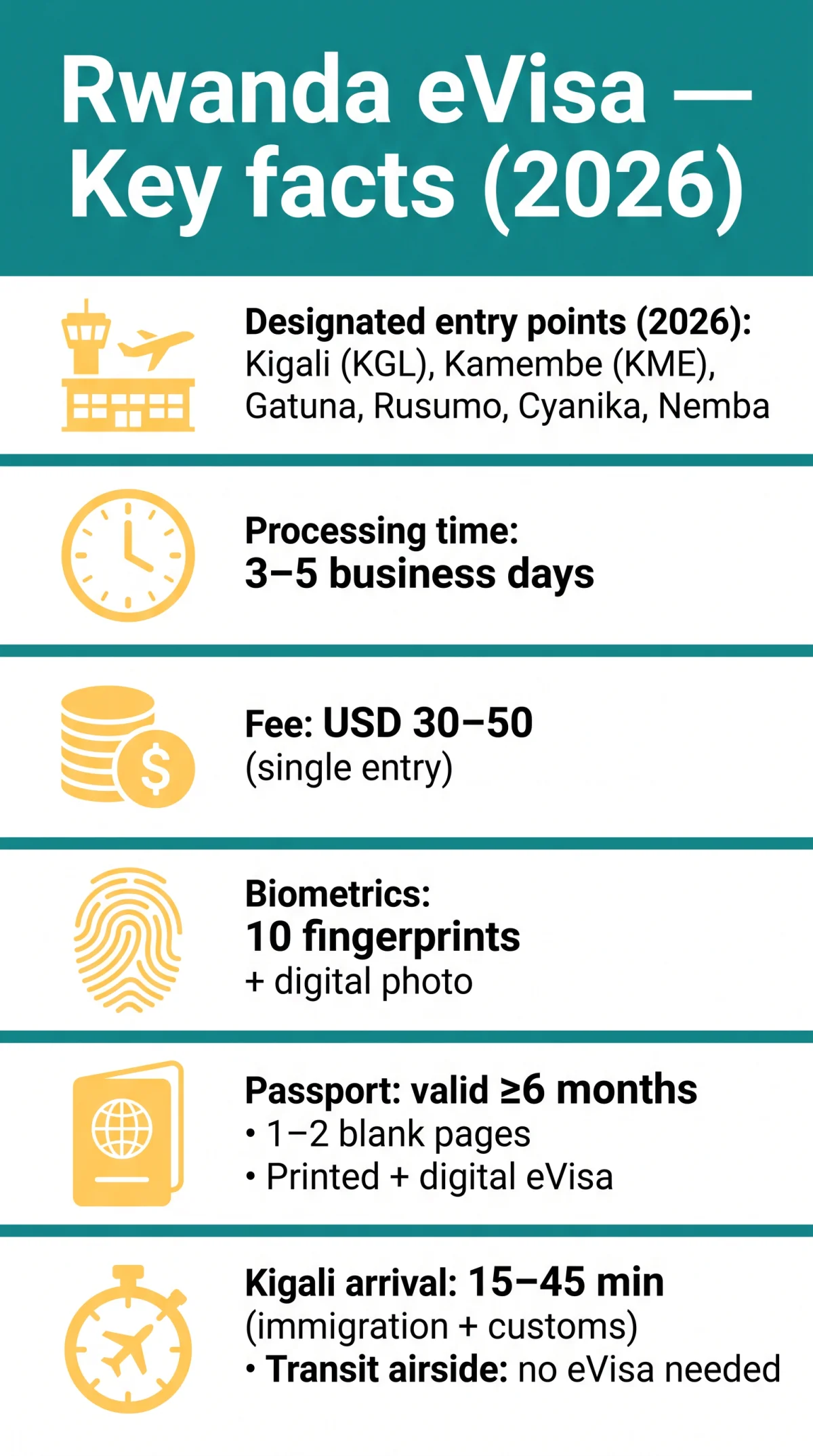
Can I enter Rwanda through any border with an eVisa? No. The Rwanda eVisa is accepted only at designated entry points, not every crossing. In 2026, eVisa holders may enter via Kigali International Airport, Kamembe Airport, and selected land borders including Gatuna, Rusumo, and Nemba. All arrivals undergo biometric screening: ten-digit fingerprint capture and a digital facial photograph.
No, you cannot enter Rwanda through any border with an eVisa. The eVisa is accepted only at designated entry points: Kigali International Airport, Kamembe Airport, and selected land border crossings including Gatuna, Rusumo, Cyanika, and Nemba. Always check the current approved list before travelling.
Published: 10 March 2026. Last reviewed: 12 September 2026 based on the latest DGIE border circular.
What Is the Rwanda eVisa and Who Needs It?
The Rwanda eVisa is an electronic travel authorisation for single-entry access, applied for online via the IremboGov portal (https://support.irembo.gov.rw/). The fee is USD 30 to 50, with processing taking 3 to 5 business days. Applicants need a passport valid for at least 6 months beyond the entry date with 1 to 2 blank pages. Work is not permitted on a visitor eVisa. Commonwealth country citizens, including UK passport holders, receive a 30-day free visa on arrival and do not need an eVisa.
Which Borders Accept the Rwanda eVisa in 2026?
The Rwanda eVisa is accepted at Kigali International Airport, Kamembe Airport, and designated land border crossings with Uganda, Tanzania, Burundi, and DR Congo. The table below is sourced from the DGIE border post directory at migration.gov.rw, accessed on 12 September 2026.
| Border Name | Type | Country | Notes |
|---|---|---|---|
| Kigali International Airport (KGL) | Airport | Rwanda | Primary entry point; e-Gates available for foreign residents with resident ID card |
| Kamembe International Airport (KME) | Airport | Rwanda | Secondary airport; serves southwestern Rwanda |
| Gatuna / Katuna | Land | Uganda | Busiest crossing; expect longest queues |
| Cyanika | Land | Uganda | Quieter alternative to Gatuna |
| Kagitumba | Land | Uganda | Northeastern crossing |
| Rubavu | Land | DR Congo | Rubavu district; Goma access |
| Rusumo | Land | Tanzania | Key crossing for Serengeti and Ngorongoro travellers |
| Nemba | Land | Burundi | Southern crossing |
| Ruhwa | Land | Burundi | Southwestern crossing |
| Grande Barriere | Land | DR Congo | Goma access; main crossing |
| Petite Barriere | Land | DR Congo | Goma access; secondary crossing |
The approved list may change; verify current eligibility at migration.gov.rw. DGIE hotline: 9090 (Mon-Fri 8:00-17:00). Land borders apply the same biometric checks as Kigali, with simpler infrastructure and shorter queues at quieter posts such as Cyanika.
Arriving at Kigali International Airport with an eVisa
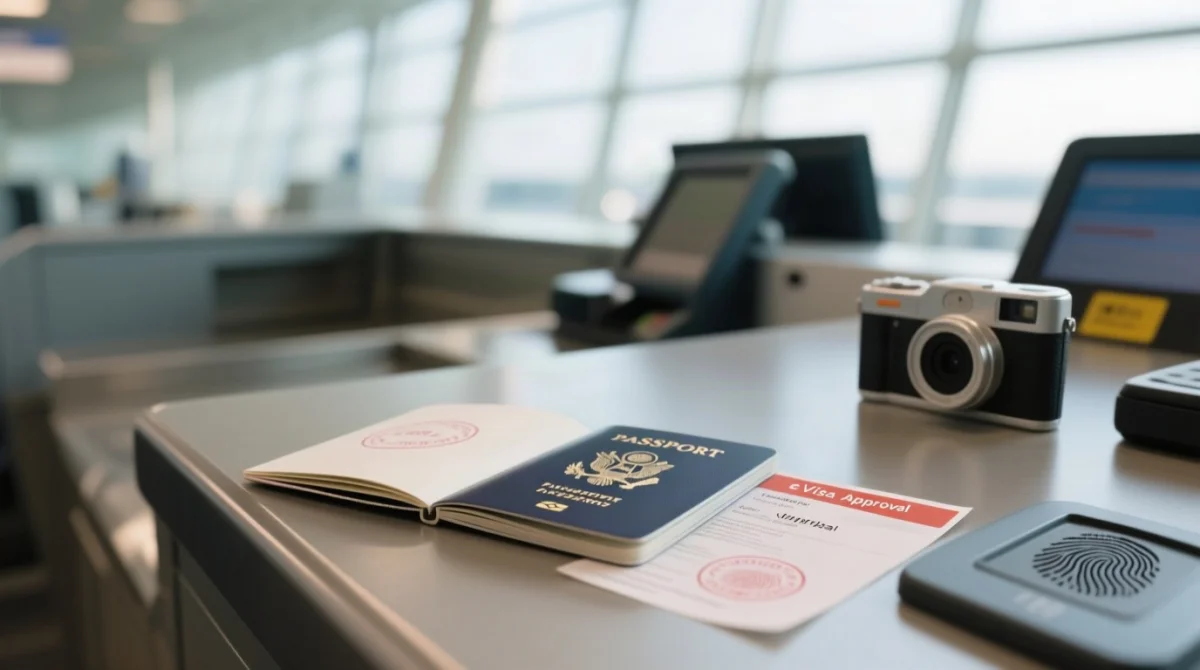
At Kigali International Airport, eVisa holders pass through immigration, complete biometric capture, receive an entry stamp, and clear customs in approximately 15-45 minutes.
Disembark and follow signs
Follow signs to the immigration hall.
Join the non-resident immigration queue
Proceed to the correct queue for non-residents.
Present your passport and eVisa approval
Officers verify it against your passport data in real time.
Undergo biometric capture
Ten-digit fingerprints (rolled and flat) and a digital facial photograph.
Receive an entry stamp
Shows date, port of entry, and permitted stay duration.
Collect baggage and pass through customs
Including a plastic bag inspection and currency declaration if carrying more than USD 10,000.
Carry printed eVisa as primary + digital PDF backup. Transit airside: no eVisa needed; leaving airport: eVisa or visa on arrival required.
Step-by-Step Border Control Process for eVisa Holders
Queue and approach
Join the immigration line with your passport and eVisa approval ready.
Document verification
The officer scans your passport biometric chip and looks up the eVisa in the DGIE system by eVisa number, confirming name, nationality, and dates.
Biometric enrolment
Ten-digit fingerprint capture (all fingers, rolled and flat) and a digital facial photograph. Remove sunglasses and hats; keep hands dry and clean.
Immigration interview
Brief questions on purpose of visit, duration of stay, accommodation address, and return or onward travel plans.
Entry stamp and clearance
The officer places an entry stamp showing date, port of entry, and permitted stay duration. Proceed to baggage claim or onward transport.
e-Gates at KGL: residents only (Rwandan ID card); eVisa tourists use staffed counters. If eVisa not found, officer calls DGIE hotline 9090 – have application number ready.
Biometric Screening and e-Gate Eligibility
Rwanda collects ten-digit fingerprints (rolled and flat) and a digital facial photograph from every arriving traveller at both airports and land border crossings. This biometric verification supports identity confirmation and anti-fraud measures.
Automated e-Gates at Kigali International Airport are currently reserved for foreign residents holding a Rwandan resident ID card. Standard eVisa holders on a visitor visa must use staffed immigration counters. If e-Gates are unavailable, the manual desk process applies with the same biometric capture steps. At land borders, there are no automated e-Gates; all biometric capture is desk-based.
Practical tips: remove glasses and sunglasses, remove hats or head coverings, keep hands dry and clean, and stand still during facial capture.
Health, Customs & Border Amenities
Rwanda enforces health screening for Yellow Fever, inspects luggage for banned plastic bags, and requires currency declarations above USD 10,000.
Travellers arriving from or transiting through Yellow Fever-endemic countries (including Uganda, Kenya, DRC, and Nigeria) must present a valid International Certificate of Vaccination (Yellow Card). Screening takes place at a health checkpoint before immigration; non-compliance may result in on-site vaccination or entry denial.
Rwanda maintains a strict ban on non-biodegradable polythene bags at all ports of entry. Luggage is scanned at customs – dispose of plastic bags before arrival and repack into fabric or paper alternatives.
Amounts exceeding USD 10,000 (or equivalent) must be declared at the customs desk. Pay at borders: USD/RWF cash accepted; cards inconsistent. ATMs at Kigali Airport only – carry sufficient cash for land crossings.
Visa Exemptions and the East Africa Tourist Visa
Commonwealth citizens, including UK passport holders, receive 30-day visa-free entry to Rwanda. The East Africa Tourist Visa (EATV) grants 90 days of multiple-entry access across Rwanda, Uganda, and Kenya, with the first entry into the EAC bloc required via Rwanda.
| Feature | Rwanda eVisa | Visa on Arrival | East Africa Tourist Visa |
|---|---|---|---|
| Entry type | Single entry | Single entry | Multiple entries |
| Duration | Per eVisa class | Per visa class | 90 days |
| Application | IremboGov online | At immigration desk | Online or on arrival |
| First entry | Any designated point | Any designated point | Must enter EAC via Rwanda |
FAQ: Rwanda eVisa Border and Airport Arrival
Can I enter Rwanda through any border with an eVisa?
No, the Rwanda eVisa is accepted only at designated entry points, not every border. In 2026, eVisa holders can enter via Kigali International Airport, Kamembe Airport, and designated land borders (see table above).
Can I use the Rwanda eVisa at a land border crossing?
Yes, at designated land borders including Gatuna, Rusumo, Nemba, and Cyanika. Not all minor posts accept the eVisa; confirm your intended crossing before travel.
What documents do I need at Rwanda border control with an eVisa?
A passport valid for at least 6 months beyond your entry date with 1 to 2 blank pages, your eVisa approval (printed or digital), and a Yellow Card if arriving from an endemic country. Carry your accommodation address and return travel details for the immigration interview.
Do I need a printed copy of the Rwanda eVisa at the border?
Rwandan immigration may accept a digital PDF on a mobile device, but carrying a printed copy as backup is strongly advised. Have both formats available.
How long does Rwanda eVisa processing take?
Rwanda eVisa processing takes 3 to 5 business days via the IremboGov portal (https://support.irembo.gov.rw/). The fee is USD 30 to 50 for single entry.
Do I need a yellow fever vaccine to enter Rwanda?
Yes, if arriving from or transiting through a Yellow Fever endemic country. Present a valid Yellow Card at the health screening point before immigration. Non-compliance may result in on-site vaccination or entry denial.
Can I get a Rwanda visa on arrival instead of applying for an eVisa?
Yes, a visa on arrival is available to all nationalities at Kigali International Airport and designated land borders. The fee is the same as the eVisa, USD 30 to 50 for single entry.
Which countries can enter Rwanda visa-free?
Commonwealth citizens, including UK passport holders, receive 30-day visa-free entry. The full list is maintained by the DGIE at migration.gov.rw.
DGIE Contact Details: Website: migration.gov.rw | General: [email protected] | Passports: [email protected] | Permits: [email protected] | Laissez-Passer: [email protected] | Phone: +250-788-152-222 | Hotline: 9090 | Hours: Mon-Fri 8:00 AM-5:00 PM | Twitter: @Rwandamigration | Address: KG 7 Ave, Kigali, Rwanda
Rwandan High Commission in the United Kingdom: Website: rwandainuk.gov.rw | High Commissioner: Johnston Busingye | Consular/Visas: [email protected] | General: [email protected] | Phone: +44 (0)207 224 9832 | Hours: Mon-Fri 9:30am-1:00pm, 2:00pm-5:00pm | Location: London